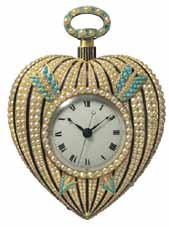
|
Museum
|
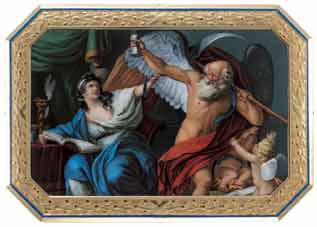
Science and Love attempting
to prevent the passing on Time after F.-G. Ménageot (1744-1816) Snuff-box
- Enamel by Jean-Abraham Lissignol, Geneva - ca. 1810.
PATEK PHILIPPE MUSEUM
The second floor (I) :
The antique collection
The sixteenth to nineteenth centuries
The second floor of the PATEK PHILIPPE MUSEUM invites the visitor to disover the first three centuries of the horological art, through five hundred of the most important pieces from Geneva's and Europe's heritage, together with a splendid collection of miniature portraits on enamel, created by the great Geneva masters.
The
first watches
When was the first watch invented? None of the experts is prepared to
hazard an opinion as to the exact date or place, or the name of an inventor.
Its ancestor, the mechanical clock, first appeared in the western world
around the twelfth century, the fruit of efforts that began some 3,500
years ago to measure time by means of sundials and clepsydras, and later,
the hourglass. The first mechanical clocks were huge constructions and
almost four centuries passed before the invention of the mainspring and
the gradual miniaturisation of parts paved the way for the timepiece that
is worn and treasured today.
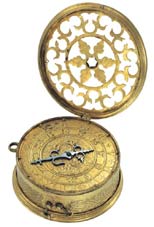
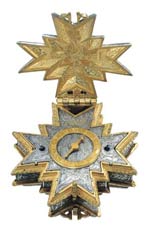
The PATEK PHILIPPE MUSEUM presents some of the finest examples of timepieces built in the period between 1500 and 1675, including an extremely old German drum-watch dating from approximately 1530-1540 and housing a movement entirely in iron, in an elegant cylindrical case of delicately engraved gilt metal (Inv. S-457). The watch in the form of the Cross of the Order of the Holy Ghost, signed by Abraham Cusin (ca. 1630-1635) (Inv. S-473) illustrates the fact that timepieces created in France almost a century later were designed to reflect, by their elaborate forms and decoration, the value attached to possessing such an instrument.
The dawn of Geneva watchmaking
From the end of the sixteenth century, the Calvinist city of Geneva sheltered many of the French Huguenots forced to flee the politics of King Charles IX, who ordered the massacre of Saint-Barthelemy in 1572. Aided by the trade guilds, the Protestant religion found a large and devoted following amongst craftsmen. The turmoil of the Reformation brought Geneva an exceptional windfall of talented artisans, and these imported skills made the city a leading influence in the complementary fields of watchmaking and miniature painting on enamel.
Richly decorated by Etienne Este, a bassine-cased watch with astronomical indications demonstrates the high level of skill achieved by the Geneva watchmakers between 1660 and 1670 (Inv. S-280). Two intriguing designs from the preceding century reflect the fact that, as an object of adornment worn at the neck or the waist, the watch could take on a symbolic meaning, either sacred or profane, and thus express the wearer's beliefs and values: the Memento Mori (~1650-60) by Marc Lagisse, whose case in the shape of a human skull reminds one that life is not eternal (Inv. S-477), and the fantastical form of the Dolphin by Jean-Baptiste Duboule (~1660), inspired by a motif dear to the nobility of the times (Inv. S-326).
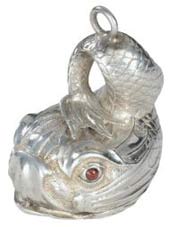
Miniature painting on enamel. From Paris...
The introduction of the exquisite art of miniature painting on enamel is attributed to the French goldsmith, Jean Toutin, in 1630, working first in Blois and then in Paris. This innovative procedure, whose extremely delicate technique is based on the ancient art of enamelling, was first used to adorn snuff-boxes and other practical objects, particularly watches. Religious and mythological subjects took centre stage, as they did in painting, in that grand siècle. With their rich palette of glowing colours, the miniatures on enamel rivalled each other by their refinement of execution. The Toutin family and its disciples were sought after by crowned heads and elegant society throughout Europe.
The PATEK PHILIPPE MUSEUM houses many masterpieces of miniature painting on enamel from this early period. Notable amongst those of religious inspiration is the magnificent watch with cover by the Parisian watchmaker, François Baronneau (~1640-45) whose opulent bassine case depicts on all its surfaces the Story of the Holy Virgin, in a series of miniature paintings attributed to the Parisian School (Inv.S-199). This artist probably also created the remarkable Passion of Christ in grisaille on a bassine-cased watch whose movement is signed by A. Mazurier (~1650). A fine book cover, painted on both sides with a Sacra Conversazione and the Adoration of the Shepherds after Titian is the work of an anonymous artist from South Germany (~1670) (Inv.E-82).
Antiquity and its mythology also inspired works of outstanding quality. A painting on enamel of Vertumnus and Pomona, on the back of a pendant with mirror dating from the 1640s, (Inv. E-86), illustrates Henri Toutin's consummate skill, inspired here by Ovid. The vivid enamels of the Theagenes and Charicleia after Charles Poerson, attributed to the Blois miniaturist Robert Vauquer(Inv.S-200), adorn a superb bassine-cased watch with cover by the Parisian, Denis Champion (~1655).
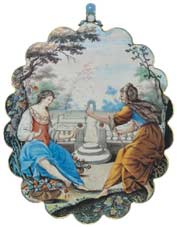
Vertumnus and Pomona Pendant with mirror. Enamel by Henri Toutin, Paris - ca. 1640.
...to Geneva
At the end of the seventeenth century, France lost all those of its miniaturists
on enamel who had adopted the Protestant faith, and they were many. A
century of religious persecution wiped out a noble tradition, which emigrated
to countries that were friendly to the Reformation, especially Geneva.
These exiled artists founded the Genevan art of painting on enamel, beginning
with the Huaud dynasty, and continuing with that of the Mussards. The
future of painting on enamel was henceforth in the hands of Geneva's artists.
The latter, either travelling the world, or working at home for the Geneva
institution known as the " Fabrique ", raised their art, now free of any
utilitarian base, to the ultimate level of refinement.
The miniature
portrait, that most formidable test of an enameller's skill, became
a privileged means of expression for the artists who forged Geneva's reputation
as the capital of craftsmanship in Europe. From 1640 to 1750, the history
of the decorative arts was enriched by the prestigious names of Petitot,
Bordier and Liotard, who frequented every Court in Europe, from England
to distant Russia. They created a strong tradition that the Geneva school
would perpetuate right up to the mid-nineteenth century.
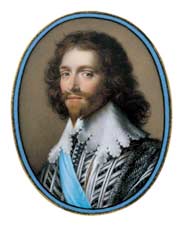
Georges Villiers, Duke of Buckingham Portrait-miniature. Enamel by Jean I Petitot, London - Dated 1640.
The PATEK PHILIPPE
MUSEUM possesses some of the greatest works by Jean Petitot, the son of
a family of Protestant refugees. His miniature portrait of Georges Villiers,
Duke of Buckingham (London, 1640, Inv.E-76) is of such quality that it
actually enhances the charm of the subject of the famous painting by Gerrit
Von Honsthorst, which no doubt inspired the enameller. This very rare
piece is one of a collection of nine miniatures from Petitot's London
period. There is also a portrait of Louis XIV, king of France, in the
original frame (Paris, ca. 1670, Inv. E-66).
The art of the pastellist, Jean-Etienne Liotard, is beautifully displayed
in a portrait of Charles-Edouard Stuart, the Young Pretender, Prince of
Scotland, in its fine original frame of enamelled gold (Rome, ca. 1736,
Inv. E-01).
These two great artists rub shoulders with other miniaturists (Louis de
Guernier, the Huaud Brothers and Gregori S. Mussikinski) and other portraits
of great historical figures, such as the Marquis of Sévigné, Sophie-Charlotte
de Hanovre and Pierre le Grand, tsar of Russia.
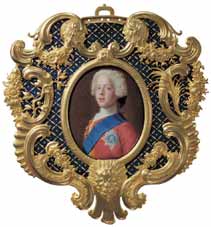
Charles-Edward Stuart, The Young Pretender, Prince of Scotland. Portrait-miniature in the original frame. Enamel by Jean-Etienne Liotard, Rome ca. 1736.
The second period, from 1760 to 1830, introduces the visitor to the miniature
portraits on enamel by artists of the Geneva school. At the time of the
French Revolution, Geneva was the acknowledged capital of this delicate
art, and possessed some eighty artists specialised in the decoration of
luxury items, mainly for export. The small number of women in the group
included the enigmatic Elisabeth Terroux, who chose to live abroad, as
did her fellow artists, Jacques Thouron and Jean-François Soiron.
In 1760, as its artistry progressed, Geneva invented " flux ", the transparent
enamel which, when applied to the painting like a varnish, gives it an
extraordinary depth and luminosity. This revolutionary technique was initially
reserved for watch cases and snuff-boxes from the " Fabrique ".
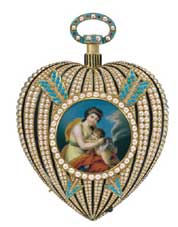
The collection's fine portraits include: Man in a brown suit, by Jean-François Favre (Geneva, dated 1778, Inv. E-117), Françoise Mégret d'Etigny by Jacques Thouron after Danloux (Genéva, 1783-85, Inv. E-133) and the Young Man in front of Lake Geneva by Jean-François Soiron (Paris,dated 1802, Inv. E127). There are also some enchanting snuff-boxes painted with miniature scenes and using the technique of enamel under flux: Science and Love attempting to stay passing time by J.-A. Lissignol, Geneva (~1810, Inv. E-149) after G. Ménageot and a View of Geneva and the Mont Blanc from Pregny, by J.-L. Richter and A.-J. Troll, Geneva (~1815, Inv. E-08).