|
Museum
|
PATEK PHILIPPE MUSEUM
The second floor (II) :
When the art of
horology becomes a science
In the second half of the seventeenth century, just as the Geneva tradition
of miniature painting on enamel was poised to emerge, a Dutchman gave
the watchmaking art the two impulses it needed to assume the status of
a science. The physicist, geometer and astronomer, Christiaan Huygens,
confirmed Galileo's intuition by demonstrating how time could be measured
by a pendulum. This first discovery was followed, in 1675, by the invention
of the sprung balance, which transformed the watch into a valued precision
instrument, thanks to the incorporation of a minute-hand around 1680.
There was thus no longer the need to re-set one's watch several times
a day; from then on the modern watch would vary by a mere one or two minutes.
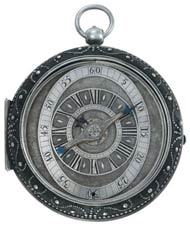
Pair-cased watch with early balance-spring, Barrow endless-screw regulator and expanding minute hand Henricus Jones, London - ca. 1675-80.
The PATEK PHILIPPE MUSEUM pays homage to the first century of scientific horology through some extraordinary timepieces whose increasing sophistication testifies to the dual quest for complication and absolute precision. Amongst the most ambitious creations on display is one of history's first timepieces with a sprung balance. Created by the London watchmaker, Henricus Jones, between 1675 and 1680, it features a Barrow endless-screw regulator and an expandable minute-hand and is the earliest known example of a watch capable of indicating the minutes (Inv. S-474). Its neighbours include other pieces of great interest, such as the quarter-repeating coach watch with Grand and Small Strike no. 1522 by the Parisian, Julien Le Roy (~1740, Inv. S-450),and the eight-day-going dead-seconds watch with seconds-beating double balance and dumb quarter repeating, by Ferdinanc Berthoud, adorned with a painting on enamel by Hamelin (Paris, ~1758-59, Inv. S-208).
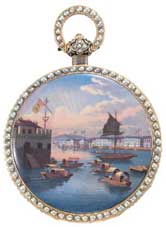
European Factories at the Port of Canton Watch made for the Chinese market - Anonyme, Geneva - ca. 1830.
The Geneva timepiece is exported to the East
After a century of honing their skills, Geneva's watchmakers began to explore the possibilities of exporting to markets in the East. The Geneva watch's travels across the world began around 1680 with Turkey, where the Swiss colony in Constantinople provided an entrée to the Sultan's court (Jean-Jacques Rousseau's father became official timer in charge of the clocks in the Topkapi Palace).
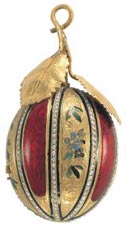
The Melon Watch-pendant with automata and music - Piguet & Capt, Geneva - ca. 1810.
Richly decorated with motifs, maps and landscapes, the " Turkish " watches in the PATEK PHILIPPE MUSEUM offer a distinctive glimpse of oriental culture and geography. A bassine-cased watch signed by the Genevan Jacques Quartier around 1670, has a lavishly engraved case whose open-work flowers shimmer in translucent enamels (Inv. S-228).
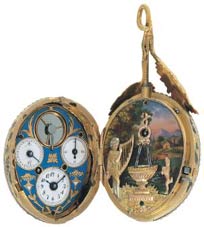
Ten years later, it was China's turn to welcome Geneva's artistry, initially through the intermediary of English merchants. The demand for Geneva's products reached its peak in the eighteenth century, under the reign of Ch'ien Lung. The so-called " Chinese " watches produced in Geneva have a discreet but charming exotic flavour and are distinguished by the fact that they were always produced in pairs. The Geneva watchmakers, inspired by this surprising requirement, went as far as creating stunning pair watches, whose decorations mirrored each other.
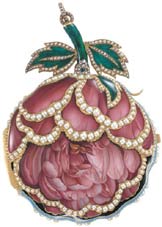
The Rose Quarter-repeating watch made for the Chinese market, movement entirely in steel - Piguet & Meylan, Geneva - ca. 1820.
A romantic pair of watches by Piguet and Meylan (1758-1823) present a painting by the miniaturist on enamel, J.-A. Lissignol, inspired by Pierre Paul Prud'hom's Love and Innocence (Inv. S-470 a+b). However, the prize exhibit must surely be the pair of mirror-image heart-shaped watches from the same team and fitted with musical automata (~1820, Inv. S-133 a +b).
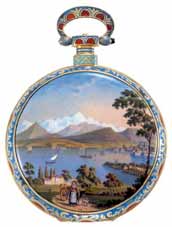
View of Geneva and the
Mont-Blanc from Pregny Watch made for the Chinese market - Ilbery London,
Geneva. Enamel attributed to Jean-Louis Richter, Geneva - ca. 1820.
The golden age of the automat
A detour by way of imperial China brings us to the threshold of the nineteenth century, where Geneva had been developing the spectacular art of the automaton for more than twenty years. Inhabited by mechanical creatures who come alive to tell us the time, the automata have every right to be called superb " timepieces ". But most of them do not stop at displaying the time. They also sing it. By means of ingenious musical devices that add further complexity to the mechanisms that animate these miniature theatre pieces, Jacquet Droz and his successors, Henri Capt, Isaac Daniel Piguet and Philippe Samuel Meylan, and later, the Rochats and the Bruguiers, succeeded in offering the world some of the the most poetic of horology's creations.
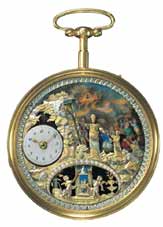
Moses Quarter-repeating watch by hammerstriking Putti. Automata hour-striking, or triggered upon request. Anonymous, Locle - ca. 1815-20.
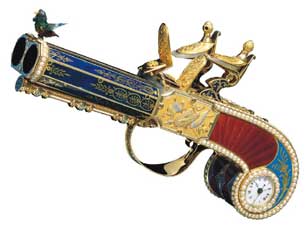
Pistol with singing-bird Ornamental watch in the shape of a flintlock double-barrelled pistol Rochat, Geneva - ca. 1810.
Delightfully eccentric
The end of the eighteenth century was also marked by the wave of eccentricity that engulfed the watchmaking industry until as late as 1830. The fashionable timepiece was no longer content to tell the time and was found in the company of objects as diverse as knives or scent bottles or small cases for a lady's personal effects. These versatile items took luxury to extremes , and were richly decorated by the period's leading goldsmiths and enamellers. The growth of mechanisation ended the fashion for these impertinent jewels.
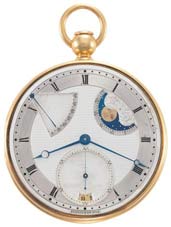
"Répétition perpétuelle à secondes" Dumb quarter-repeating self-winding watch constructed on the principle of the "garde-temps" with date, phases and age of the moon and power reserve indication - Abraham-Louis Breguet, Paris. Sold on April 16, 1829, to the Parisian banker, the Baron Anselme de Rothschild.
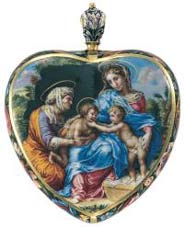
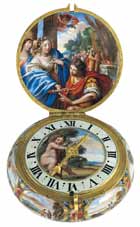
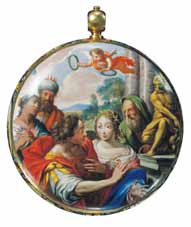
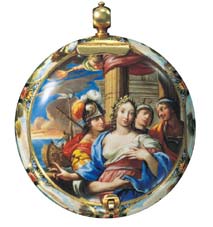
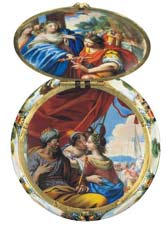
The Small Holy Family after Guilio Romano (1575-1642) "Bassine"-cased watch in the shape of a heart Johann Martin, Augsburg - ca. 1675.
The invention of the modern watch
We must now back-track to the end of the eighteenth century and the physicist Huygen's worthy successor, Abraham-Louis Breguet. Under his influence, watchmaking made such enormous technical and aesthetic progress that he has since been considered the father of modern horology. This creator of a phenomenal range of inventions, including the constant-force escapement, the natural escapement, the parachute shock-absorber and the tourbillon regulator, was born in Neuchâtel in 1747 and set up his workshops in Paris, where his magnificent timepieces attracted all the most prominent personalities of the times. His watch no. 160, commissioned for Queen Marie-Antoinette by an officer of the queen's guard, has gone down in history as the first of the world's most complicated timepieces. Breguet died in 1823, and his son took over the reins of the business, which continued to flourish until the 1850s. At that time, the Geneva firm of Patek Philippe moved to the forefront and came to represent, to the world's most eminent figures, what Breguet had been for one hundred years
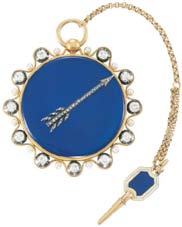
"Médaillon savonnette à tact" Hunting-cased watch with tactile hour indication - Abraham-Louis Breguet, Paris - 1800-01. Sold on "3 Messidor, An IX" (June 22, 1801) to Lucien Bonaparte (1775-1840), Prince of Canino.
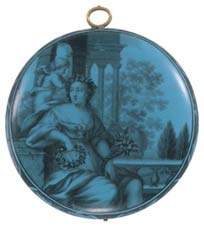
Flora and Cupid "Bassine"-cased watch in "grisaille" on a "bleu-mourant" background Henry Grendon, London Enamel attributed to a French Huguenot workshop established in London ca. 1645-50.