|
Which
the consumer often doesn't know Applied to the watch, the term of
"water-resistance" has its own rules which are defined by an international
standard, ISO 2281. The words "water-resistant" and/or "étanche"
(the only ones officially agreed), engraved on the dial or on the
case back cover, signify that the watch successfully went through
the water-resistance tests enjoyed by the above mentioned standard
during its production and in particular during the assembling process.
It should be observed that the terms "showerproof" or "water-proof"
are commercial appellations : they are referring to any test method.
To be able to be called "water-resistant",
a watch has to go successfully through to types of control :
1) The 10 cm water control
The watch is immersed in 10 cm of water and kept without moving
during one hour. The test is made under ambient water temperature
of 18° and 25°C.
Further on, still immersed under 10 cm of water, the test continues
under different temperatures : 40°C during 5 minutes, 20°C during
5 minutes and 40°C during 5 minutes.
2) Control of the water pressure
The watch is immersed in a water container during 5 minutes, where
the pressure corresponding to the depth (in meters) engraved on
the dial or on the case back cover is applied. This pressure has
to achieve at minimum 2 bars or 2 atmospheres, (2 kg/force per cm2),
which corresponds to a depth of 20 m.
The checking of the water-resistance is effected after having made
before and after each immersion a condensation test.
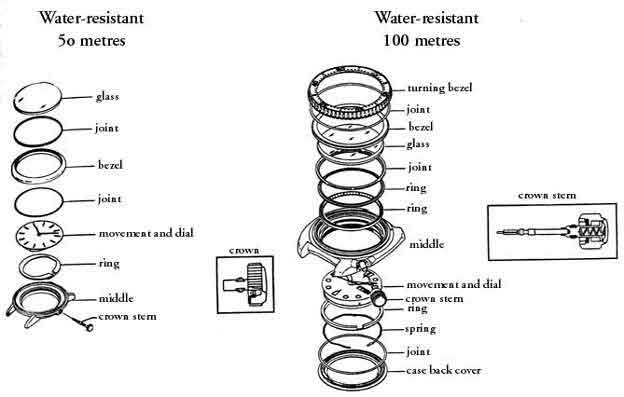
Three categories of "water-resistant" watches are
existing :
|
|
1st category (simple water-resistant
watches)
The inside of the watch is protected against humidity (perspiration,
rain drop, etc.). The test foresees that the watch has to go through
a 30 minutes immersion at a 1m depth. This watch category shouldn't
be bored by taking a bath.
2nd category (water-resistant watches for every day's use)
This type of watches can be bored in the water, but only by swimming
and not for diving purposes. The water-resistance level is normally
engraved on the dial or the case back cover (10 m, 20 m or 30 m).
It's important to take notice that a 30 m water-resistant watch
should not be immersed or exposed to a stream under pressure (a
shower for instance). As for 50 m water-resistant watches, the consumer
can take a bath in a swimming pool, a header overboard, but not
from a diving-board. The deep plunges are not recommended as well
as some violent water-sports. Only if the case back cover is made
out of stainless steel, the watch can be bored into the sea.
3rd category (diver's watch)
Generally these watches are resistant up to 100 m or 200 m, some
of them even 1000 m. In addition to water-resistance tests corresponding
to the foreseen depth, the diver's watches have to be equipped with
the following parts : unidirectional turning bezels divided from
5 minutes to 5 minutes, indexes and hands luminescent and readable
in the water from a distance of 25 cm; the watches have to be antimagnetic,
shock-resistant, resistant against salt water and the atmosphere
containing helium.
A 100 m water-resistant watch can be carried by bathe, header over
board in swimming-pools or under the water, but not when plunging
with bottles or by professional diving needing the use of helium
and consequently a water-resistant watch at a minimum of 600 m.
|
|
As
you can notice, the offer of watch-resistant watches of different
levels depend on what you will do with them. Buying this type of
watches, you have to know what kind of requirements you have and
therefore ask what they are able to offer in order to avoid a later
deceit. In the same way, when you give your watch for a service
(cleaning, battery changing, etc.), which requires the opening of
the case, you will have to get the insurance that the resistance
checks have been made after the service. Please take notice that
a water condensation under the dial proves that the watch is no
longer water-resistant and has to be serviced and checked again.
|