Flat polishing
or specular polishing
Preamble :
A number of articles have been dedicated to the fundamental notions
of high-end finishes. Above and beyond the complication of the
movement and its technical reliability, it is the level of finish
that makes all the difference.
As explained previously, a complicated watch is not necessarily
a top-of-the-range watch. In order to achieve perfection in a
watch, each detail is taken into account so as to achieve the
finest result in terms of quality of finish and aesthetics.
We have listed the various types of high-end finish (graining,
polishing, milling, matt appearance, bevelling). Nonetheless,
we should specify that some elements play a determining role in
terms of aesthetics and enable us to distinguish between the various
degrees of high-end finish.
According to the state of the surface achieved, an expert eye
will be able to define the working method used, sometimes constituting
a genuine quality label for the finish. In order to provide more
concrete information, we will deal in more detail with certain
issues and types of decoration which might appear superfluous
or even insignificant to the layperson, but prove extremely important
for the connoisseur.
Nota bene : ... by black polish or specular polish, which is the
final decorative touch but is particularly spectacular in aesthetic
terms (see opposite).
Flat or
black polishing
Polishing
and smoothing consist in reducing the roughness of the surface
of the matter with the help of various tools and materials.
By means of these procedures, the crystal tips of the surface
of metals are partly removed and partly squashed down into the
hollows.
These finishing techniques give the treated surfaces a smooth
appearance, which may result in the specular or black polish.
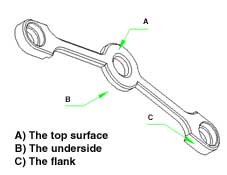
At the top of the range, for certain parts such as repeater hammers,
indexes, endpieces or tourbillon bridges, the visible surface
must have this specular polish.
This is a particularly spectacular type of decoration. The luminous
reflections give more depth to the entire movement .
The
use of specular or black polish :
Specular polish or black polish serves first of all the practical
purpose of reducing the risk of oxidation, but this extreme form
of polishing plays a primarily aesthetic role.
This procedure can achieve fascinating and indeed unique optical
effects.
Once the parts are assembled, the way the watch is turned towards
the light can result in reflections that are white*(photo 4),grey
*(photo 5) or black * (photo 6), creating kaleidoscopic luminous
effects.
Flat
polish or black polish : the method
The polishing operation enabling one to achieve this state of
surface, giving a mirror-like appearance to parts, is called
flat polishing or black polishing.
Flat polishing or black polishing is part of the decorations that
are particularly representative of the top of the range and require
dexterity, patience and tremendous cleanliness.
There are various tricks of the trade and ways of doing things,
but we will mention only the main ones :
- the modern method
- the high-end method
1)The modern method :
In this case, rigid abrasive papers are used (such as aluminium
oxide) resulting in a part that is shiny but not transcendent
in optical terms, since the surface is not perfectly smooth (not
black polished).
This method takes only between 10 to 20 minutes.
2)The high-end method :
a) Preparation
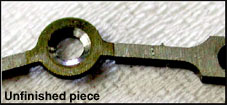
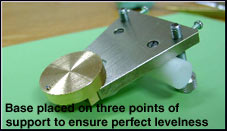
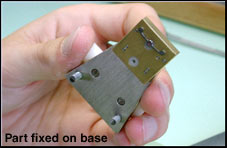
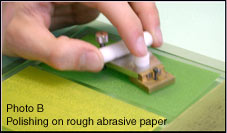
First of all, the goal is to achieve a perfectly smooth surface
by using rough abrasives to rub down down a part stuck to a base
resting on three points of support * (photoA and photo B).
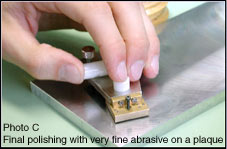
b) Polishing
The next stage is to strive for perfection in polishing by rubbing
the part with a very fine abrasive (diamond paste) on a zinc plaque
that has been carefully straightened flat and rid of all impurities
that might embed themselves in the matter and scratch the part
*(photo C).
This method calls for two to five hours of work and a great deal
of care.
The aim of the operation is to make the surface of the part extremely
smooth and polished in order to achieve a luminous reflection
virtually perpendicular to the face, hence the black zones which
are not only very difficult to achieve but also exceptionally
beautiful.
At the opposite end of the spectrum, the modern method does not
create any emotions, since the parts are shiny but with no highlights
due to the rounded angles and the lack of levelness of the surface
(the reflections point out in all directions).
Conclusion :
A specular or black polish calls for a great deal of time and
care, and the cost of parts is thus considerable higher than polishing
on paper. For all these reasons, companies often choose the modern
polishing method, considering it to be satisfactory but above
all fast and less expensive.
See: Bevelling
and finishes...(III)